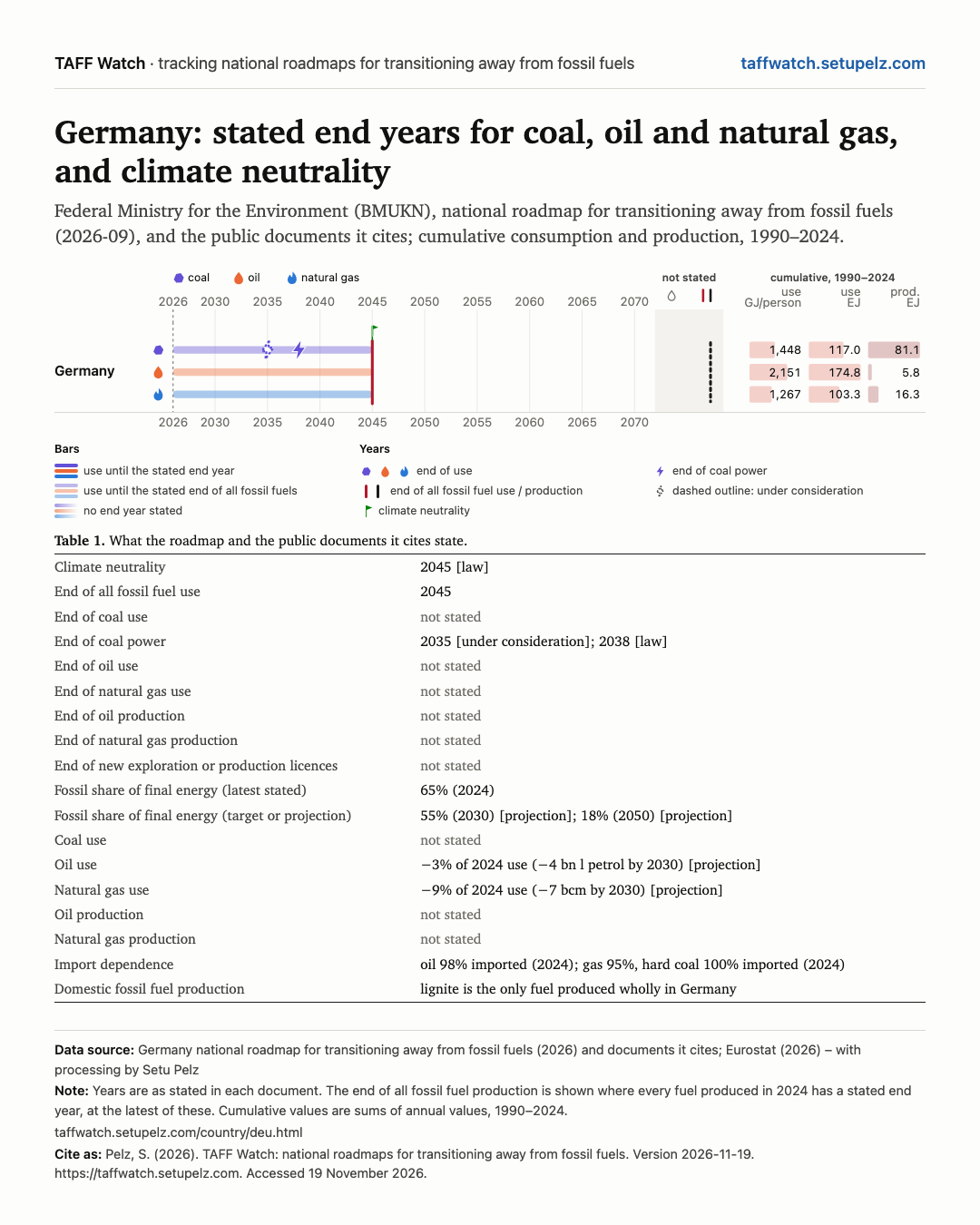
Germany
What Germany's roadmap for transitioning away from fossil fuels states, with the public documents it cites. Every value is given with its quote, page and status.
1. Documents
- Federal Ministry for the Environment (BMUKN) (2026-09). Germany's Roadmap for Transitioning Away from Fossil Fuels. 22 pp., en. Publisher copy · archived copy.
- Supporting document: Umweltbundesamt (UBA) (2026-06). Treibhausgas-Projektionen 2026 für Deutschland (Projektionsbericht 2026). de. Publisher copy.
2. Summary
| Field | Stated | Source |
|---|---|---|
| Climate neutrality | 2045 [law] | p. 6 |
| End of all fossil fuel use | 2045 | p. 4 |
| End of coal use | not stated | |
| End of coal power | 2035 [under consideration] 2038 [law] |
p. 10 p. 10 |
| End of oil use | not stated | |
| End of natural gas use | not stated | |
| End of coal production | not stated | |
| End of oil production | not stated | |
| End of natural gas production | not stated | |
| End of new exploration or production licences | not stated | |
| Fossil share of final energy (latest stated) | 65% (2024) | p. 5 |
| Fossil share of final energy (target or projection) | 55% (2030) [projection] 18% (2050) [projection] |
p. 74 (supp.) p. 74 (supp.) |
| Oil use | −3% of 2024 use (−4 bn l petrol by 2030) [projection] | p. 9 |
| Natural gas use | −9% of 2024 use (−7 bcm by 2030) [projection] | p. 9 |
| Coal use | not stated | |
| Oil production | not stated | |
| Natural gas production | not stated | |
| Import dependence | oil 98% imported (2024) gas 95%, hard coal 100% imported (2024) |
p. 5 p. 5 |
| Domestic fossil fuel production | lignite is the only fuel produced wholly in Germany | p. 5 |
| Power | 2045 | p. 10 |
| Buildings | 60% (2040) [law] | p. 14 |
| Transport | 100% (2035) [projection] | p. 13 |
| Industry | 2045 | p. 15 |
| Support for transitions abroad | 8 statements | quotes |
Values are targets unless marked [law], [projection] or [under consideration]. † Final-energy value from Eurostat or converted from the document's primary-energy figure (see Methods). Source column links to the quote below.
3. Energy use and production, 1990–2024
Source: Eurostat energy balances. Consumption is final energy use, excluding non-energy use such as feedstocks; production is primary production. Eurostat had not published 2025 balances at retrieval.
Coal, oil, natural gas and peat as a share of all final energy use, including electricity and heat (Eurostat). Hover or tap the chart for values by year.
Table
| Year | Fossil share (%) |
|---|---|
| 1990 | 76.6 |
| 1991 | 76.5 |
| 1992 | 76.3 |
| 1993 | 76.7 |
| 1994 | 76.3 |
| 1995 | 76.1 |
| 1996 | 76.7 |
| 1997 | 75.9 |
| 1998 | 75.3 |
| 1999 | 74.6 |
| 2000 | 74.3 |
| 2001 | 74.1 |
| 2002 | 73.0 |
| 2003 | 70.5 |
| 2004 | 69.3 |
| 2005 | 68.2 |
| 2006 | 67.6 |
| 2007 | 64.8 |
| 2008 | 66.0 |
| 2009 | 65.6 |
| 2010 | 64.7 |
| 2011 | 64.2 |
| 2012 | 64.0 |
| 2013 | 64.8 |
| 2014 | 64.7 |
| 2015 | 64.8 |
| 2016 | 65.2 |
| 2017 | 65.1 |
| 2018 | 64.6 |
| 2019 | 65.0 |
| 2020 | 64.5 |
| 2021 | 63.5 |
| 2022 | 63.1 |
| 2023 | 62.8 |
| 2024 | 62.2 |
Energy delivered to end users from each fossil fuel, excluding feedstocks (Eurostat energy balances), in petajoules. Hover or tap the chart for values by year.
- Coal
- Oil
- Natural gas
Table
| Year | Coal (PJ) | Oil (PJ) | Natural gas (PJ) |
|---|---|---|---|
| 1990 | 1,608.0 | 3,859.8 | 1,541.1 |
| 1991 | 1,115.1 | 4,157.2 | 1,687.8 |
| 1992 | 829.0 | 4,171.2 | 1,721.3 |
| 1993 | 694.7 | 4,278.9 | 1,831.9 |
| 1994 | 620.4 | 4,125.6 | 1,873.3 |
| 1995 | 556.4 | 4,137.2 | 2,018.6 |
| 1996 | 527.2 | 4,274.3 | 2,272.9 |
| 1997 | 485.8 | 4,195.0 | 2,169.2 |
| 1998 | 420.6 | 4,159.3 | 2,171.8 |
| 1999 | 376.4 | 3,997.0 | 2,183.8 |
| 2000 | 363.8 | 3,863.1 | 2,218.2 |
| 2001 | 336.8 | 3,956.5 | 2,258.1 |
| 2002 | 322.5 | 3,775.9 | 2,257.3 |
| 2003 | 342.3 | 3,690.2 | 2,228.1 |
| 2004 | 305.0 | 3,565.7 | 2,242.2 |
| 2005 | 274.5 | 3,440.3 | 2,202.9 |
| 2006 | 308.6 | 3,467.7 | 2,241.5 |
| 2007 | 283.5 | 2,982.3 | 2,147.0 |
| 2008 | 273.1 | 3,282.8 | 2,202.1 |
| 2009 | 233.6 | 3,122.4 | 2,047.8 |
| 2010 | 285.2 | 3,137.9 | 2,260.6 |
| 2011 | 311.8 | 3,027.1 | 2,017.6 |
| 2012 | 287.5 | 3,038.2 | 2,106.0 |
| 2013 | 279.1 | 3,152.5 | 2,212.5 |
| 2014 | 268.4 | 3,085.4 | 1,985.7 |
| 2015 | 301.9 | 3,057.9 | 2,064.2 |
| 2016 | 287.4 | 3,080.8 | 2,194.5 |
| 2017 | 282.3 | 3,084.1 | 2,209.5 |
| 2018 | 261.8 | 2,937.6 | 2,227.2 |
| 2019 | 240.2 | 3,033.3 | 2,192.4 |
| 2020 | 239.6 | 2,830.2 | 2,179.8 |
| 2021 | 222.0 | 2,632.8 | 2,392.7 |
| 2022 | 240.6 | 2,687.3 | 2,081.7 |
| 2023 | 217.5 | 2,579.0 | 1,912.7 |
| 2024 | 199.2 | 2,541.3 | 1,885.2 |
Domestic primary production of each fossil fuel (Eurostat energy balances), in petajoules. Hover or tap the chart for values by year.
- Coal
- Oil
- Natural gas
Table
| Year | Coal (PJ) | Oil (PJ) | Natural gas (PJ) |
|---|---|---|---|
| 1990 | 5,094.9 | 224.0 | 566.6 |
| 1991 | 4,441.6 | 191.0 | 566.6 |
| 1992 | 4,086.1 | 182.0 | 574.5 |
| 1993 | 3,673.0 | 173.2 | 575.8 |
| 1994 | 3,387.5 | 165.5 | 597.3 |
| 1995 | 3,303.6 | 163.1 | 632.2 |
| 1996 | 3,092.8 | 158.1 | 683.4 |
| 1997 | 2,962.4 | 157.0 | 673.2 |
| 1998 | 2,717.2 | 162.0 | 656.1 |
| 1999 | 2,644.7 | 160.5 | 699.5 |
| 2000 | 2,537.2 | 183.9 | 661.5 |
| 2001 | 2,434.6 | 182.3 | 667.0 |
| 2002 | 2,442.8 | 194.6 | 669.4 |
| 2003 | 2,415.7 | 203.5 | 666.7 |
| 2004 | 2,441.4 | 203.5 | 609.1 |
| 2005 | 2,363.8 | 213.6 | 600.1 |
| 2006 | 2,228.2 | 213.0 | 624.5 |
| 2007 | 2,276.2 | 211.8 | 622.1 |
| 2008 | 2,095.8 | 200.8 | 551.5 |
| 2009 | 1,942.0 | 182.0 | 545.0 |
| 2010 | 1,922.0 | 153.7 | 465.3 |
| 2011 | 1,955.1 | 159.4 | 456.1 |
| 2012 | 1,992.8 | 156.4 | 400.6 |
| 2013 | 1,886.4 | 156.0 | 371.2 |
| 2014 | 1,847.7 | 143.9 | 287.4 |
| 2015 | 1,800.5 | 148.2 | 265.2 |
| 2016 | 1,663.2 | 150.6 | 274.3 |
| 2017 | 1,651.4 | 147.8 | 252.4 |
| 2018 | 1,585.1 | 146.2 | 197.4 |
| 2019 | 1,189.9 | 134.5 | 183.1 |
| 2020 | 979.2 | 130.3 | 168.8 |
| 2021 | 1,153.2 | 124.6 | 161.9 |
| 2022 | 1,192.8 | 119.0 | 151.2 |
| 2023 | 916.1 | 114.3 | 134.2 |
| 2024 | 825.6 | 117.6 | 127.5 |
4. Quotes for Table 1
Overall
“The Federal Climate Action Act also lays down the legally binding target of achieving net greenhouse gas neutrality by 2045.”Germany's Roadmap for Transitioning Away from Fossil Fuels, p. 6 · publisher copy · archived copy, p. 6
“in order to achieve its goal of climate neutrality and thus transition away from the use of fossil fuels no later than 2045”Germany's Roadmap for Transitioning Away from Fossil Fuels, p. 4 · publisher copy · archived copy, p. 4
End of use
“The German government is also exploring the option of bringing forward to 2035 the final phase-out deadline.”Germany's Roadmap for Transitioning Away from Fossil Fuels, p. 10 · publisher copy · archived copy, p. 10
“All coal-fired power plants are required to end operations no later than 2038.”Germany's Roadmap for Transitioning Away from Fossil Fuels, p. 10 · publisher copy · archived copy, p. 10
End of production
Fossil share of final energy
Use and production paths
“This will make it possible to use almost seven billion cubic metres less of natural gas and some four billion litres less of petrol by 2030.”Germany's Roadmap for Transitioning Away from Fossil Fuels, p. 9 · publisher copy · archived copy, p. 9
“This will make it possible to use almost seven billion cubic metres less of natural gas and some four billion litres less of petrol by 2030.”Germany's Roadmap for Transitioning Away from Fossil Fuels, p. 9 · publisher copy · archived copy, p. 9
Imports and domestic production
“Lignite is the only fuel produced wholly inside Germany.”Germany's Roadmap for Transitioning Away from Fossil Fuels, p. 5 · publisher copy · archived copy, p. 5
Sector milestones
“Overall, the German government is striving to decarbonise all power plants in line with climate targets by 2045 at the latest.”Germany's Roadmap for Transitioning Away from Fossil Fuels, p. 10 · publisher copy · archived copy, p. 10
“Anyone who replaces an old heating system with a new gas or oil heating system after 29 July 2026 will, from 2029 onwards, gradually use an increasing share of carbon-neutral fuels (60% from 2040).”Germany's Roadmap for Transitioning Away from Fossil Fuels, p. 14 · publisher copy · archived copy, p. 14
“for passenger cars in particular, the percentage of first-time registrations of battery electric cars will be high even before 2030, rising to 100 percent by 2035”Germany's Roadmap for Transitioning Away from Fossil Fuels, p. 13 · publisher copy · archived copy, p. 13
“In the industrial sector too, action is guided by the goal of achieving climate neutrality by 2045.”Germany's Roadmap for Transitioning Away from Fossil Fuels, p. 15 · publisher copy · archived copy, p. 15
Support for transitions abroad (8)
5. All recorded statements
59 statements, grouped by the three pillars of the COP30 Presidency's TAFF Roadmap.
Energy demand (25)
“in order to achieve its goal of climate neutrality and thus transition away from the use of fossil fuels no later than 2045”Germany's Roadmap for Transitioning Away from Fossil Fuels, p. 4 · publisher copy · archived copy, p. 4
“In 2024, fossil fuels accounted for almost 65% of Germany’s final energy consumption.”Germany's Roadmap for Transitioning Away from Fossil Fuels, p. 5 · publisher copy · archived copy, p. 5
“Mineral oils were responsible for 36% of consumption, followed by natural gas (24%) and coal (4%).”Germany's Roadmap for Transitioning Away from Fossil Fuels, p. 5 · publisher copy · archived copy, p. 5
“Mineral oils were responsible for 36% of consumption, followed by natural gas (24%) and coal (4%).”Germany's Roadmap for Transitioning Away from Fossil Fuels, p. 5 · publisher copy · archived copy, p. 5
“Mineral oils were responsible for 36% of consumption, followed by natural gas (24%) and coal (4%).”Germany's Roadmap for Transitioning Away from Fossil Fuels, p. 5 · publisher copy · archived copy, p. 5
“This will make it possible to use almost seven billion cubic metres less of natural gas and some four billion litres less of petrol by 2030.”Germany's Roadmap for Transitioning Away from Fossil Fuels, p. 9 · publisher copy · archived copy, p. 9
“This will make it possible to use almost seven billion cubic metres less of natural gas and some four billion litres less of petrol by 2030.”Germany's Roadmap for Transitioning Away from Fossil Fuels, p. 9 · publisher copy · archived copy, p. 9
“for passenger cars in particular, the percentage of first-time registrations of battery electric cars will be high even before 2030, rising to 100 percent by 2035”Germany's Roadmap for Transitioning Away from Fossil Fuels, p. 13 · publisher copy · archived copy, p. 13
“32.4% of all passenger cars registered for the first time in August 2026 were battery electric vehicles.”Germany's Roadmap for Transitioning Away from Fossil Fuels, p. 11 · publisher copy · archived copy, p. 11
“The most recent forecast of the German Environment Agency (UBA) points to a total of 7 million battery electric passenger cars on roads by 2030.”Germany's Roadmap for Transitioning Away from Fossil Fuels, p. 13 · publisher copy · archived copy, p. 13
“This would translate as 17 million by 2035.”Germany's Roadmap for Transitioning Away from Fossil Fuels, p. 13 · publisher copy · archived copy, p. 13
“Anyone who replaces an old heating system with a new gas or oil heating system after 29 July 2026 will, from 2029 onwards, gradually use an increasing share of carbon-neutral fuels (60% from 2040).”Germany's Roadmap for Transitioning Away from Fossil Fuels, p. 14 · publisher copy · archived copy, p. 14
“suppliers of gas, oil and liquefied natural gas will in future be required to ensure that, from 2045, the fuels used for heating buildings are switched entirely to climate-neutral fuels”Germany's Roadmap for Transitioning Away from Fossil Fuels, p. 14 · publisher copy · archived copy, p. 14
“In 2025 some 300,000 heat pumps were sold in Germany, making this the most frequently purchased heating technology and giving it a market share of 48%.”Germany's Roadmap for Transitioning Away from Fossil Fuels, p. 13 · publisher copy · archived copy, p. 13
“They are expected to account for significantly more than 70% of all new heating systems sold.”Germany's Roadmap for Transitioning Away from Fossil Fuels, p. 14 · publisher copy · archived copy, p. 14
“In the industrial sector too, action is guided by the goal of achieving climate neutrality by 2045.”Germany's Roadmap for Transitioning Away from Fossil Fuels, p. 15 · publisher copy · archived copy, p. 15
“In industry, electricity accounted for a substantial 31% of final energy consumption in 2024.”Germany's Roadmap for Transitioning Away from Fossil Fuels, p. 15 · publisher copy · archived copy, p. 15
“It is expected that hydrocarbons will continue to be needed for material applications, and these must be gradually defossilised.”Germany's Roadmap for Transitioning Away from Fossil Fuels, p. 16 · publisher copy · archived copy, p. 16
“While, for example, around two thirds of final energy carriers are still fossil in 2026, their share falls to around 55% in 2030 and around 18% in 2050.” (own translation; original: “Während z. B. im Jahr 2026 noch rund zwei Drittel der Endenergieträger fossil sind, reduziert sich deren Anteil auf rund 55 % im Jahr 2030 und rund 18 % im Jahr 2050.”)Treibhausgas-Projektionen 2026 für Deutschland (Projektionsbericht 2026), p. 74 (supporting document) · publisher copy
“While, for example, around two thirds of final energy carriers are still fossil in 2026, their share falls to around 55% in 2030 and around 18% in 2050.” (own translation; original: “Während z. B. im Jahr 2026 noch rund zwei Drittel der Endenergieträger fossil sind, reduziert sich deren Anteil auf rund 55 % im Jahr 2030 und rund 18 % im Jahr 2050.”)Treibhausgas-Projektionen 2026 für Deutschland (Projektionsbericht 2026), p. 74 (supporting document) · publisher copy
“The MMS shows a decline in heating oil of 23% between 2024 and 2030, from 144 TWh to 111 TWh.” (own translation; original: “Das MMS verzeichnet zwischen 2024 und 2030 einen Rückgang von Heizöl um 23 %, von 144 TWh auf 111 TWh.”)Treibhausgas-Projektionen 2026 für Deutschland (Projektionsbericht 2026), p. 153 (supporting document) · publisher copy
“The projected use of natural gas falls by 31% between 2024 and 2030, from 337 TWh to 233 TWh.” (own translation; original: “Der projizierte Einsatz von Erdgas sinkt zwischen 2024 und 2030 um 31 %, von 337 TWh auf 233 TWh.”)Treibhausgas-Projektionen 2026 für Deutschland (Projektionsbericht 2026), p. 153 (supporting document) · publisher copy
“decline in fossil energy use (2024: 352 TWh, 2030: 266 TWh, 2045: 183 TWh)” (own translation; original: “Rückgang des fossilen Energieeinsatzes (2024: 352 TWh, 2030: 266 TWh, 2045: 183 TWh)”)Treibhausgas-Projektionen 2026 für Deutschland (Projektionsbericht 2026), p. 108 (supporting document) · publisher copy
“Demand for fossil fuels falls to 82 TWh by 2045” (own translation; original: “Der Bedarf an fossilen Kraftstoffen geht bis zum Jahr 2045 auf 82 TWh zurück”)Treibhausgas-Projektionen 2026 für Deutschland (Projektionsbericht 2026), p. 176 (supporting document) · publisher copy
“The projected use of lignite falls to 76 PJ by 2030.” (own translation; original: “Der projizierte Einsatz von Braunkohle geht bis 2030 auf 76 PJ zurück.”)Treibhausgas-Projektionen 2026 für Deutschland (Projektionsbericht 2026), p. 67 (supporting document) · publisher copy
Energy supply (14)
“in 2024 Germany imported some 98% of the mineral oils it used, along with some 95% of natural gas and 100% of hard coal”Germany's Roadmap for Transitioning Away from Fossil Fuels, p. 5 · publisher copy · archived copy, p. 5
“in 2024 Germany imported some 98% of the mineral oils it used, along with some 95% of natural gas and 100% of hard coal”Germany's Roadmap for Transitioning Away from Fossil Fuels, p. 5 · publisher copy · archived copy, p. 5
“Lignite is the only fuel produced wholly inside Germany.”Germany's Roadmap for Transitioning Away from Fossil Fuels, p. 5 · publisher copy · archived copy, p. 5
“Overall, the German government is striving to decarbonise all power plants in line with climate targets by 2045 at the latest.”Germany's Roadmap for Transitioning Away from Fossil Fuels, p. 10 · publisher copy · archived copy, p. 10
“the percentage of gross electricity consumption generated from renewables is to be increased to at least 80% by 2030”Germany's Roadmap for Transitioning Away from Fossil Fuels, p. 10 · publisher copy · archived copy, p. 10
“All coal-fired power plants are required to end operations no later than 2038.”Germany's Roadmap for Transitioning Away from Fossil Fuels, p. 10 · publisher copy · archived copy, p. 10
“The German government is also exploring the option of bringing forward to 2035 the final phase-out deadline.”Germany's Roadmap for Transitioning Away from Fossil Fuels, p. 10 · publisher copy · archived copy, p. 10
“new power plants receiving funding to ensure the security of supply must be hydrogen-ready and that operations must be climate-neutral no later than 2045”Germany's Roadmap for Transitioning Away from Fossil Fuels, p. 11 · publisher copy · archived copy, p. 11
“Germany has also resolved to establish the conditions for the increased use of climate-neutral fuels in gas-fired power plants already in the 2030s.”Germany's Roadmap for Transitioning Away from Fossil Fuels, p. 11 · publisher copy · archived copy, p. 11
“a minimum of 30% of Germany’s heat networks must be powered by renewables or unavoidable waste heat by 2030, with this figure rising to 80% by 2040”Germany's Roadmap for Transitioning Away from Fossil Fuels, p. 14 · publisher copy · archived copy, p. 14
“a minimum of 30% of Germany’s heat networks must be powered by renewables or unavoidable waste heat by 2030, with this figure rising to 80% by 2040”Germany's Roadmap for Transitioning Away from Fossil Fuels, p. 14 · publisher copy · archived copy, p. 14
“By 2045 Germany’s heat networks will have to be completely climate-neutral.”Germany's Roadmap for Transitioning Away from Fossil Fuels, p. 14 · publisher copy · archived copy, p. 14
“achieve the Global Methane Pledge’s target of reducing methane emissions by at least 30% of 2020 levels by 2030”Germany's Roadmap for Transitioning Away from Fossil Fuels, p. 19 · publisher copy · archived copy, p. 19
“Net electricity generation from fossil fuels falls from 202 TWh to 87 TWh between 2024 and 2050.” (own translation; original: “Die Nettostromerzeugung aus fossilen Brennstoffen geht im Zeitraum von 2024 bis 2050 von 202 TWh auf 87 TWh zurück.”)Treibhausgas-Projektionen 2026 für Deutschland (Projektionsbericht 2026), p. 83 (supporting document) · publisher copy
Broader economy (12)
“This roadmap lays out the policy framework and the key strategies Germany will be pursuing in the various sectors”Germany's Roadmap for Transitioning Away from Fossil Fuels, p. 4 · publisher copy · archived copy, p. 4
“The Federal Climate Action Act also lays down the legally binding target of achieving net greenhouse gas neutrality by 2045.”Germany's Roadmap for Transitioning Away from Fossil Fuels, p. 6 · publisher copy · archived copy, p. 6
“Germany is required by law to reduce emissions of greenhouse gases by at least 65% of 1990 levels by 2030, rising to at least 88% by 2040.”Germany's Roadmap for Transitioning Away from Fossil Fuels, p. 6 · publisher copy · archived copy, p. 6
“Germany is required by law to reduce emissions of greenhouse gases by at least 65% of 1990 levels by 2030, rising to at least 88% by 2040.”Germany's Roadmap for Transitioning Away from Fossil Fuels, p. 6 · publisher copy · archived copy, p. 6
“the German government recognises that fossil fuels will continue to be used for a transitional period”Germany's Roadmap for Transitioning Away from Fossil Fuels, p. 19 · publisher copy · archived copy, p. 19
“The German government adopted a new Climate Action Programme on 25 March 2026.”Germany's Roadmap for Transitioning Away from Fossil Fuels, p. 8 · publisher copy · archived copy, p. 8
“A total of some 2.8 billion euros in funding is to be made available by 2029 within the limits of available budgetary resources.”Germany's Roadmap for Transitioning Away from Fossil Fuels, p. 12 · publisher copy · archived copy, p. 12
“Germany’s 2026 Climate Action Programme extends road toll exemptions for electric heavy-duty vehicles until mid-2031.”Germany's Roadmap for Transitioning Away from Fossil Fuels, p. 12 · publisher copy · archived copy, p. 12
“by 2030 a total of some 44 billion euros will be provided within the limits of available budgetary resources”Germany's Roadmap for Transitioning Away from Fossil Fuels, p. 15 · publisher copy · archived copy, p. 15
“In Germany some 85% of emissions are currently covered by the EU’s Emissions Trading System or by national emissions trading”Germany's Roadmap for Transitioning Away from Fossil Fuels, p. 17 · publisher copy · archived copy, p. 17
“ETS 2 is to become fully operational in 2028 and cover emissions from buildings, road transport and other sectors”Germany's Roadmap for Transitioning Away from Fossil Fuels, p. 17 · publisher copy · archived copy, p. 17
“the German government is to provide funding for the affected regions until the end of the 2030s”Germany's Roadmap for Transitioning Away from Fossil Fuels, p. 17 · publisher copy · archived copy, p. 17