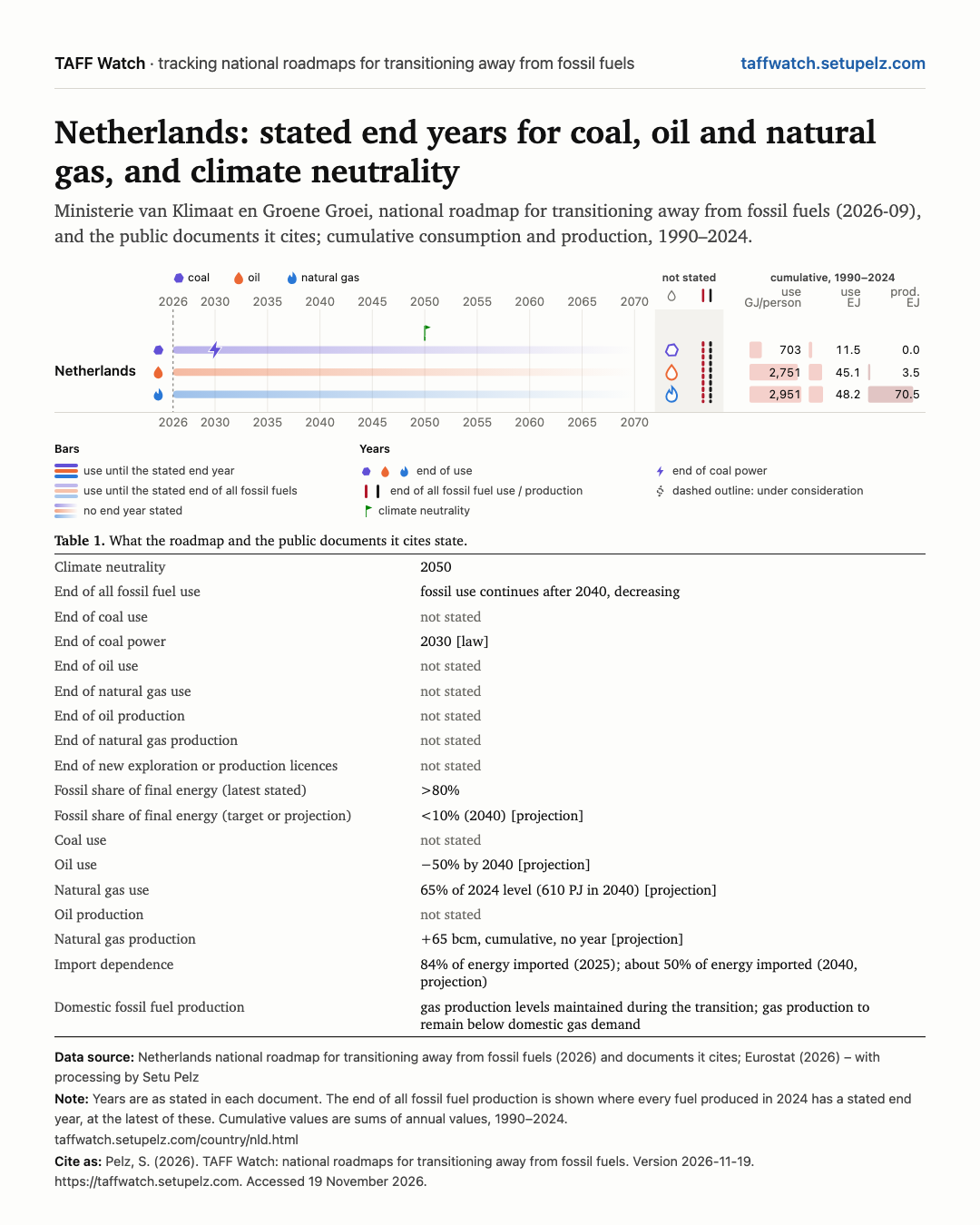
Netherlands
What Netherlands's roadmap for transitioning away from fossil fuels states, with the public documents it cites. Every value is given with its quote, page and status.
1. Documents
- Ministerie van Klimaat en Groene Groei (2026-09). Nationaal Plan Energiesysteem, Actualisatie 2026. 68 pp., nl. Publisher copy · archived copy.
- Supporting document: Ministerie van Klimaat en Groene Groei (2026-09). Nationaal Plan Energiesysteem, Actualisatie 2026: Verdiepingsdocument. nl. Publisher copy.
- Supporting document: Minister van Klimaat en Groene Groei (2025-04-23). Kamerbrief Sectorakkoord Gaswinning in de Energietransitie (Kamerstukken II 2024/25, 33 529, nr. 1293). nl. Publisher copy.
2. Summary
| Field | Stated | Source |
|---|---|---|
| Climate neutrality | 2050 | p. 2 |
| End of all fossil fuel use | fossil use continues after 2040, decreasing | p. 49 |
| End of coal use | not stated | |
| End of coal power | 2030 [law] | p. 126 (supp.) |
| End of oil use | not stated | |
| End of natural gas use | not stated | |
| End of coal production | not stated | |
| End of oil production | not stated | |
| End of natural gas production | not stated | |
| End of new exploration or production licences | not stated | |
| Fossil share of final energy (latest stated) | >80% | p. 122 (supp.) |
| Fossil share of final energy (target or projection) | <10% (2040) [projection] | p. 213 (supp.) |
| Oil use | −50% by 2040 [projection] | p. 212 (supp.) |
| Natural gas use | 65% of 2024 level (610 PJ in 2040) [projection] | p. 49 |
| Coal use | not stated | |
| Oil production | not stated | |
| Natural gas production | +65 bcm, cumulative, no year [projection] | p. 2 (supp.) |
| Import dependence | 84% of energy imported (2025) about 50% of energy imported (2040, projection) |
p. 24 p. 25 |
| Domestic fossil fuel production | gas production levels maintained during the transition gas production to remain below domestic gas demand |
p. 49 p. 130 (supp.) |
| Power | 90% (2040) | p. 36 |
| Buildings | 200,000 connections (2030) | p. 46 |
| Transport | −40–−35% by 2040 [projection] | p. 20 |
| Industry | 7.5 Mt CO2/year (2030) | p. 66 |
| Support for transitions abroad | 3 statements | quotes |
Values are targets unless marked [law], [projection] or [under consideration]. † Final-energy value from Eurostat or converted from the document's primary-energy figure (see Methods). Source column links to the quote below.
3. Energy use and production, 1990–2024
Source: Eurostat energy balances. Consumption is final energy use, excluding non-energy use such as feedstocks; production is primary production. Eurostat had not published 2025 balances at retrieval.
Coal, oil, natural gas and peat as a share of all final energy use, including electricity and heat (Eurostat). Hover or tap the chart for values by year.
Table
| Year | Fossil share (%) |
|---|---|
| 1990 | 82.2 |
| 1991 | 82.5 |
| 1992 | 81.9 |
| 1993 | 81.6 |
| 1994 | 79.3 |
| 1995 | 78.3 |
| 1996 | 78.8 |
| 1997 | 76.2 |
| 1998 | 74.6 |
| 1999 | 74.4 |
| 2000 | 74.0 |
| 2001 | 74.0 |
| 2002 | 73.4 |
| 2003 | 73.5 |
| 2004 | 72.9 |
| 2005 | 72.5 |
| 2006 | 73.3 |
| 2007 | 71.7 |
| 2008 | 72.1 |
| 2009 | 72.3 |
| 2010 | 73.7 |
| 2011 | 71.6 |
| 2012 | 72.7 |
| 2013 | 72.5 |
| 2014 | 70.0 |
| 2015 | 71.1 |
| 2016 | 71.7 |
| 2017 | 71.6 |
| 2018 | 70.8 |
| 2019 | 69.7 |
| 2020 | 68.8 |
| 2021 | 69.0 |
| 2022 | 66.8 |
| 2023 | 66.9 |
| 2024 | 65.2 |
Energy delivered to end users from each fossil fuel, excluding feedstocks (Eurostat energy balances), in petajoules. Hover or tap the chart for values by year.
- Coal
- Oil
- Natural gas
Table
| Year | Coal (PJ) | Oil (PJ) | Natural gas (PJ) |
|---|---|---|---|
| 1990 | 25.9 | 558.2 | 897.0 |
| 1991 | 21.7 | 550.2 | 999.7 |
| 1992 | 18.4 | 567.3 | 949.4 |
| 1993 | 20.8 | 581.9 | 974.0 |
| 1994 | 13.7 | 571.8 | 920.4 |
| 1995 | 13.4 | 568.3 | 952.7 |
| 1996 | 13.2 | 593.1 | 1,073.1 |
| 1997 | 15.0 | 579.3 | 927.9 |
| 1998 | 12.6 | 581.8 | 895.0 |
| 1999 | 11.9 | 608.1 | 866.6 |
| 2000 | 10.8 | 599.3 | 864.2 |
| 2001 | 11.0 | 610.1 | 880.6 |
| 2002 | 10.8 | 626.4 | 847.5 |
| 2003 | 11.0 | 636.9 | 861.8 |
| 2004 | 12.1 | 638.0 | 863.3 |
| 2005 | 11.8 | 638.7 | 837.2 |
| 2006 | 13.0 | 671.7 | 812.2 |
| 2007 | 14.7 | 668.7 | 753.0 |
| 2008 | 14.0 | 656.6 | 802.5 |
| 2009 | 12.0 | 632.4 | 784.3 |
| 2010 | 13.1 | 652.3 | 902.0 |
| 2011 | 12.4 | 635.8 | 756.2 |
| 2012 | 12.7 | 624.5 | 793.8 |
| 2013 | 11.7 | 595.7 | 815.7 |
| 2014 | 12.0 | 560.3 | 669.4 |
| 2015 | 17.1 | 565.0 | 709.9 |
| 2016 | 19.2 | 579.7 | 733.0 |
| 2017 | 20.6 | 586.6 | 727.3 |
| 2018 | 18.8 | 589.9 | 721.2 |
| 2019 | 16.3 | 572.0 | 697.3 |
| 2020 | 15.2 | 523.2 | 666.8 |
| 2021 | 15.1 | 516.8 | 717.8 |
| 2022 | 17.3 | 505.9 | 566.9 |
| 2023 | 15.5 | 519.9 | 530.0 |
| 2024 | 19.2 | 521.7 | 518.5 |
Domestic primary production of each fossil fuel (Eurostat energy balances), in petajoules. Hover or tap the chart for values by year.
- Oil
- Natural gas
Table
| Year | Oil (PJ) | Natural gas (PJ) |
|---|---|---|
| 1990 | 174.8 | 2,283.0 |
| 1991 | 168.8 | 2,581.2 |
| 1992 | 153.1 | 2,592.2 |
| 1993 | 152.1 | 2,642.4 |
| 1994 | 198.7 | 2,506.6 |
| 1995 | 157.0 | 2,548.2 |
| 1996 | 140.2 | 2,883.9 |
| 1997 | 135.6 | 2,554.2 |
| 1998 | 123.3 | 2,436.4 |
| 1999 | 119.4 | 2,265.6 |
| 2000 | 111.1 | 2,209.0 |
| 2001 | 105.1 | 2,327.3 |
| 2002 | 138.4 | 2,286.7 |
| 2003 | 141.8 | 2,185.8 |
| 2004 | 128.7 | 2,578.2 |
| 2005 | 106.6 | 2,352.0 |
| 2006 | 94.6 | 2,322.1 |
| 2007 | 117.9 | 2,232.1 |
| 2008 | 98.5 | 2,552.7 |
| 2009 | 80.4 | 2,358.0 |
| 2010 | 68.5 | 2,709.6 |
| 2011 | 68.7 | 2,501.9 |
| 2012 | 70.8 | 2,462.5 |
| 2013 | 72.6 | 2,606.6 |
| 2014 | 87.4 | 2,173.9 |
| 2015 | 86.5 | 1,651.7 |
| 2016 | 67.8 | 1,594.7 |
| 2017 | 63.4 | 1,365.5 |
| 2018 | 63.9 | 1,169.5 |
| 2019 | 48.0 | 998.9 |
| 2020 | 44.8 | 723.4 |
| 2021 | 48.1 | 648.8 |
| 2022 | 30.9 | 539.4 |
| 2023 | 28.1 | 354.7 |
| 2024 | 25.6 | 300.2 |
4. Quotes for Table 1
Overall
“the end goal of a climate-neutral Netherlands in 2050” (own translation; original: “het einddoel van een klimaatneutraal Nederland in 2050”)Nationaal Plan Energiesysteem, Actualisatie 2026, p. 2 · publisher copy · archived copy, p. 2
“Also after 2040 the Netherlands is expected to still use fossil energy carriers, though to a decreasing extent” (own translation; original: “Ook na 2040 is de verwachting dat Nederland nog gebruik zal maken van fossiele energiedragers, al zal dit in afnemende mate zijn”)Nationaal Plan Energiesysteem, Actualisatie 2026, p. 49 · publisher copy · archived copy, p. 49
End of use
“The use of coal in electricity generation is prohibited from 2030.” (own translation; original: “De inzet van kolen in de elektriciteitsproductie is vanaf 2030 verboden.”)Nationaal Plan Energiesysteem, Actualisatie 2026: Verdiepingsdocument, p. 126 (supporting document) · publisher copy
End of production
Fossil share of final energy
Use and production paths
“with coal consumption (almost) completely gone, use of crude oil and oil products roughly halving and use of fossil natural gas falling by about 55%” (own translation; original: “waarbij het verbruik van kolen (nagenoeg) volledig verdwenen is, inzet van aardolie en aardolieproducten ongeveer halveert en de inzet van fossiel aardgas met zo’n 55% afneemt”)Nationaal Plan Energiesysteem, Actualisatie 2026: Verdiepingsdocument, p. 212 (supporting document) · publisher copy
“In the NPE figures the role of (natural) gas falls to about 610 PJ in 2040, compared with 935 PJ in 2025.” (own translation; original: “In het NPE-cijferbeeld daalt de rol van (aard)gas tot zo’n 610 PJ in 2040, ten opzichte van 935 PJ in 2025.”)Nationaal Plan Energiesysteem, Actualisatie 2026, p. 49 · publisher copy · archived copy, p. 49
“The measures in this agreement are expected to lead to additional production of 65 billion m3 of natural gas.” (own translation; original: “De maatregelen in dit akkoord zullen naar verwachting leiden tot een extra productie van 65 miljard m3 aardgas.”)Kamerbrief Sectorakkoord Gaswinning in de Energietransitie (Kamerstukken II 2024/25, 33 529, nr. 1293), p. 2 (supporting document) · publisher copy
Imports and domestic production
“during the transition the government aims to maintain gas production levels for security of supply and to limit the climate impact of our gas use” (own translation; original: “tijdens de transitie zet het kabinet in op het op peil houden van gaswinning met oog op leveringszekerheid en het beperken van de klimaateffecten van ons gasgebruik”)Nationaal Plan Energiesysteem, Actualisatie 2026, p. 49 · publisher copy · archived copy, p. 49
“Current and future Dutch gas production will remain at least below the level of domestic natural gas demand.” (own translation; original: “De huidige en de toekomstige Nederlandse gaswinning zal ten minste onder het niveau van de binnenlandse aardgasvraag blijven.”)Nationaal Plan Energiesysteem, Actualisatie 2026: Verdiepingsdocument, p. 130 (supporting document) · publisher copy
Sector milestones
“Scaling up wind, solar PV and nuclear to a share of the electricity mix >90% in 2040” (own translation; original: “Opschaling windenergie, zon-PV en kernenergie tot aandeel elektriciteitsmix >90% in 2040”)Nationaal Plan Energiesysteem, Actualisatie 2026, p. 36 · publisher copy · archived copy, p. 36
“The target for connecting existing homes to collective heat has been revised from 500,000 in NPE 2023 to 200,000 additional connections in 2030, to keep a more realistic level of ambition.” (own translation; original: “De doelstelling voor het aansluiten van bestaande woningen op collectieve warmte is bijgesteld van 500.000 in het NPE 2023 naar 200.000 extra aansluitingen in 2030 om een realistischer ambitieniveau te hanteren.”)Nationaal Plan Energiesysteem, Actualisatie 2026, p. 46 · publisher copy · archived copy, p. 46
“this leads to an estimated 35-40% lower energy use for national mobility in 2040” (own translation; original: “leidt dit voor nationale mobiliteit in 2040 naar schatting tot 35- 40% lager energiegebruik”)Nationaal Plan Energiesysteem, Actualisatie 2026, p. 20 · publisher copy · archived copy, p. 20
“NPE: Aramis start volume (7.5 Mt per year) operational in 2030” (own translation; original: “NPE: startvolume Aramis (7.5Mt per jaar) in 2030 operationeel”)Nationaal Plan Energiesysteem, Actualisatie 2026, p. 66 · publisher copy · archived copy, p. 66
Support for transitions abroad (3)
“phase-down of fossil fuels and the build-up of clean global energy supply chains” (own translation; original: “afbouw van fossiele brandstoffen en de opbouw van schone mondiale energieketens”)Nationaal Plan Energiesysteem, Actualisatie 2026, p. 51 · publisher copy · archived copy, p. 51
“In addition the Netherlands works to strengthen global partnerships, in particular through cooperation with energy-producing countries and countries in the Global South.” (own translation; original: “Daarnaast zet Nederland in op het versterken van mondiale partnerschappen, met name door samenwerking met energieproducerende landen en landen in het mondiale Zuiden.”)Nationaal Plan Energiesysteem, Actualisatie 2026, p. 51 · publisher copy · archived copy, p. 51
“cooperation aimed at the responsible phase-out of fossil subsidies and reducing global demand for fossil fuels, as co-initiator of the first conference on Transitioning Away from Fossil Fuels in Santa Marta earlier this year” (own translation; original: “samenwerking gericht op het verantwoord afbouwen van fossiele subsidies en het verminderen van de mondiale vraag naar fossiele brandstoffen, als mede-initiatiefnemer van de eerste conferentie over het wegbewegen van fossiele brandstoffen (Transitioning Away from Fossil Fuels) in Santa Marta eerder dit jaar”)Nationaal Plan Energiesysteem, Actualisatie 2026, p. 52 · publisher copy · archived copy, p. 52
5. All recorded statements
63 statements, grouped by the three pillars of the COP30 Presidency's TAFF Roadmap.
Energy demand (30)
“both for building the future sustainable energy system and for ensuring the responsible phase-down of fossil energy use” (own translation; original: “zowel voor de opbouw van het toekomstig duurzame energiesysteem, als voor het borgen van het verantwoord afbouwen van het fossiele energiegebruik”)Nationaal Plan Energiesysteem, Actualisatie 2026, p. 6 · publisher copy · archived copy, p. 6
“The combined share of electricity and renewable heat in final energy use for these sectors thereby rises from 26% now to around 60-70% in 2040” (own translation; original: “Het gezamenlijke aandeel van elektriciteit en hernieuwbare warmte in het finaal energiegebruik stijgt voor deze sectoren daardoor van 26% nu naar circa 60-70% in 2040”)Nationaal Plan Energiesysteem, Actualisatie 2026, p. 16 · publisher copy · archived copy, p. 16
“An example is the hybrid heat pump for households, with which gas demand can usually be reduced quickly and substantially.” (own translation; original: “Een voorbeeld hiervan is de hybride warmtepomp voor huishoudens, waarmee de gasvraag meestal snel, fors kan worden verlaagd.”)Nationaal Plan Energiesysteem, Actualisatie 2026, p. 17 · publisher copy · archived copy, p. 17
“this leads to an estimated 35-40% lower energy use for national mobility in 2040” (own translation; original: “leidt dit voor nationale mobiliteit in 2040 naar schatting tot 35- 40% lager energiegebruik”)Nationaal Plan Energiesysteem, Actualisatie 2026, p. 20 · publisher copy · archived copy, p. 20
“In the built environment total energy demand will fall towards 2040 and dependence on natural gas decreases.” (own translation; original: “In de gebouwde omgeving zal de totale energievraag richting 2040 dalen en neemt de afhankelijkheid van aardgas af.”)Nationaal Plan Energiesysteem, Actualisatie 2026, p. 31 · publisher copy · archived copy, p. 31
“Nevertheless natural gas will still play a notable role in this sector in 2040.” (own translation; original: “Toch zal aardgas ook in 2040 nog een noemenswaardige rol spelen in deze sector.”)Nationaal Plan Energiesysteem, Actualisatie 2026, p. 31 · publisher copy · archived copy, p. 31
“In aviation, maritime and inland shipping the share of renewable fuels will rise towards 2040, although fossil fuels remain the main component of the fuels.” (own translation; original: “In de lucht-, zee- en binnenvaart zal richting 2040 het aandeel hernieuwbare brandstoffen toenemen, al blijven fossiele brandstoffen nog het hoofdbestanddeel van de brandstoffen.”)Nationaal Plan Energiesysteem, Actualisatie 2026, p. 31 · publisher copy · archived copy, p. 31
“The share of electricity in total final energy use will rise from about 25% in 2025 to about 35% in 2035 and about 50% in 2040.” (own translation; original: “Het aandeel elektriciteit in het totale eindgebruik van energie zal toenemen van ca. 25% in 2025, naar ca. 35% in 2035 en ca. 50% in 2040.”)Nationaal Plan Energiesysteem, Actualisatie 2026, p. 34 · publisher copy · archived copy, p. 34
“The share of electricity in total final energy use will rise from about 25% in 2025 to about 35% in 2035 and about 50% in 2040.” (own translation; original: “Het aandeel elektriciteit in het totale eindgebruik van energie zal toenemen van ca. 25% in 2025, naar ca. 35% in 2035 en ca. 50% in 2040.”)Nationaal Plan Energiesysteem, Actualisatie 2026, p. 34 · publisher copy · archived copy, p. 34
“with the aim of thereby decarbonising, on average, the equivalent of 10 TWh of electricity per year over the next fifteen years” (own translation; original: “met als doel om hiermee de komende vijftien jaar, gemiddeld jaarlijks het equivalent van 10 TWh elektriciteit te verduurzamen”)Nationaal Plan Energiesysteem, Actualisatie 2026, p. 36 · publisher copy · archived copy, p. 36
“Policy focuses primarily on decarbonising existing grey hydrogen production and petrochemical residual gases via CCS, and on production from residual waste gasification, with a combined potential of about 15 megatonnes of CO2 reduction.” (own translation; original: “Het beleid richt zich primair op verduurzaming van bestaande grijze waterstofproductie en petrochemische restgassen via CCS, en op productie uit restafvalvergassing, met een gezamenlijke potentie van circa 15 megaton CO2-reductie.”)Nationaal Plan Energiesysteem, Actualisatie 2026, p. 41 · publisher copy · archived copy, p. 41
“Nevertheless, in a climate-neutral 2050 there will still be considerable demand for carbon carriers. That demand must then be met as far as possible from sustainable rather than fossil sources.” (own translation; original: “Desondanks zal in een klimaatneutraal 2050 ook nog een aanzienlijke vraag bestaan naar koolstofdragers. Die vraag moet dan zoveel mogelijk worden ingevuld met duurzame in plaats van fossiele bronnen.”)Nationaal Plan Energiesysteem, Actualisatie 2026, p. 42 · publisher copy · archived copy, p. 42
“The aim is to introduce a blending obligation from 1 January 2027, obliging energy suppliers to blend an increasing percentage of green gas into the natural gas they supply to households and businesses.” (own translation; original: “Het streven is om per 1 januari 2027 een bijmengverplichting in te voeren, waarmee energieleveranciers verplicht worden een toenemend percentage groen gas bij te mengen in het aardgas dat zij aan huishoudens en bedrijven leveren.”)Nationaal Plan Energiesysteem, Actualisatie 2026, p. 43 · publisher copy · archived copy, p. 43
“The target for connecting existing homes to collective heat has been revised from 500,000 in NPE 2023 to 200,000 additional connections in 2030, to keep a more realistic level of ambition.” (own translation; original: “De doelstelling voor het aansluiten van bestaande woningen op collectieve warmte is bijgesteld van 500.000 in het NPE 2023 naar 200.000 extra aansluitingen in 2030 om een realistischer ambitieniveau te hanteren.”)Nationaal Plan Energiesysteem, Actualisatie 2026, p. 46 · publisher copy · archived copy, p. 46
“A responsible phase-down of the use of fossil energy is urgently needed.” (own translation; original: “Verantwoorde afbouw van het gebruik van fossiele energie is hard nodig.”)Nationaal Plan Energiesysteem, Actualisatie 2026, p. 49 · publisher copy · archived copy, p. 49
“In the NPE figures the role of (natural) gas falls to about 610 PJ in 2040, compared with 935 PJ in 2025.” (own translation; original: “In het NPE-cijferbeeld daalt de rol van (aard)gas tot zo’n 610 PJ in 2040, ten opzichte van 935 PJ in 2025.”)Nationaal Plan Energiesysteem, Actualisatie 2026, p. 49 · publisher copy · archived copy, p. 49
“Also after 2040 the Netherlands is expected to still use fossil energy carriers, though to a decreasing extent” (own translation; original: “Ook na 2040 is de verwachting dat Nederland nog gebruik zal maken van fossiele energiedragers, al zal dit in afnemende mate zijn”)Nationaal Plan Energiesysteem, Actualisatie 2026, p. 49 · publisher copy · archived copy, p. 49
“2029 Standard for hybrid, smart heating installations in the built environment” (own translation; original: “2029 Normering hybride, slimme verwarmingsinstallaties gebouwde omgeving”)Nationaal Plan Energiesysteem, Actualisatie 2026, p. 65 · publisher copy · archived copy, p. 65
“NPE: Aramis start volume (7.5 Mt per year) operational in 2030” (own translation; original: “NPE: startvolume Aramis (7.5Mt per jaar) in 2030 operationeel”)Nationaal Plan Energiesysteem, Actualisatie 2026, p. 66 · publisher copy · archived copy, p. 66
“NPE: Responsible phase-down of fossil carbon and scale-up of sustainable carbon. Fully circular in 2050” (own translation; original: “NPE: Verantwoorde afbouw fossiele koolstof en opschaling duurzame koolstof. Volledig circulair in 2050”)Nationaal Plan Energiesysteem, Actualisatie 2026, p. 66 · publisher copy · archived copy, p. 66
“At present more than 80 percent of our energy use is still fossil; this will continue to fall steadily in the coming years.” (own translation; original: “Op dit moment is nog meer dan 80 procent van ons energiegebruik fossiel, in de komende jaren gaat dit gestaag verder dalen.”)Nationaal Plan Energiesysteem, Actualisatie 2026: Verdiepingsdocument, p. 122 (supporting document) · publisher copy
“In final end use, fossil energy carriers still represent less than 10% of total energy demand.” (own translation; original: “In het finaal eindgebruik vertegenwoordigen fossiele energiedragers nog minder dan 10% van de totale energievraag.”)Nationaal Plan Energiesysteem, Actualisatie 2026: Verdiepingsdocument, p. 213 (supporting document) · publisher copy
“oil, natural gas and coal in the Dutch energy and feedstock system to eventually zero, and minimising fossil use in 2050” (own translation; original: “olie, aardgas en kolen, in het energie- en grondstoffensysteem108 van Nederland tot uiteindelijk nul, en het minimaliseren van fossiel gebruik in 2050”)Nationaal Plan Energiesysteem, Actualisatie 2026: Verdiepingsdocument, p. 123 (supporting document) · publisher copy
“This roughly halves coal use between 2035 and 2037.” (own translation; original: “Dit halveert grof genomen tussen 2035 en 2037 het kolengebruik.”)Nationaal Plan Energiesysteem, Actualisatie 2026: Verdiepingsdocument, p. 126 (supporting document) · publisher copy
“with coal consumption (almost) completely gone, use of crude oil and oil products roughly halving and use of fossil natural gas falling by about 55%” (own translation; original: “waarbij het verbruik van kolen (nagenoeg) volledig verdwenen is, inzet van aardolie en aardolieproducten ongeveer halveert en de inzet van fossiel aardgas met zo’n 55% afneemt”)Nationaal Plan Energiesysteem, Actualisatie 2026: Verdiepingsdocument, p. 212 (supporting document) · publisher copy
“with coal consumption (almost) completely gone, use of crude oil and oil products roughly halving and use of fossil natural gas falling by about 55%” (own translation; original: “waarbij het verbruik van kolen (nagenoeg) volledig verdwenen is, inzet van aardolie en aardolieproducten ongeveer halveert en de inzet van fossiel aardgas met zo’n 55% afneemt”)Nationaal Plan Energiesysteem, Actualisatie 2026: Verdiepingsdocument, p. 212 (supporting document) · publisher copy
“with coal consumption (almost) completely gone, use of crude oil and oil products roughly halving and use of fossil natural gas falling by about 55%” (own translation; original: “waarbij het verbruik van kolen (nagenoeg) volledig verdwenen is, inzet van aardolie en aardolieproducten ongeveer halveert en de inzet van fossiel aardgas met zo’n 55% afneemt”)Nationaal Plan Energiesysteem, Actualisatie 2026: Verdiepingsdocument, p. 212 (supporting document) · publisher copy
“These figures assume total methane demand of about 405 PJ, of which about 290 PJ is still met with fossil natural gas.” (own translation; original: “Deze cijferbasis gaat uit van een totale methaanvraag van zo’n 405 PJ, waarvan nog zo’n 290 PJ met fossiel aardgas wordt ingevuld.”)Nationaal Plan Energiesysteem, Actualisatie 2026: Verdiepingsdocument, p. 213 (supporting document) · publisher copy
“Municipalities direct the neighbourhood approach and, once the Municipal Instruments for the Heat Transition Act enters into force, can phase out natural gas supply at neighbourhood level through their designation power.” (own translation; original: “Gemeenten hebben de regie op de wijkaanpak en kunnen na de inwerkingtreding van de Wet Gemeentelijke Instrumenten Warmtetransitie via de aanwijsbevoegdheid aardgaslevering op wijkniveau uitfaseren.”)Nationaal Plan Energiesysteem, Actualisatie 2026: Verdiepingsdocument, p. 128 (supporting document) · publisher copy
“demand standards such as the EU ban on the sale of fossil-fuel cars from 2035” (own translation; original: “vraagnormering zoals het EU-verbod op de verkoop van fossiele brandstofauto’s vanaf 2035”)Nationaal Plan Energiesysteem, Actualisatie 2026: Verdiepingsdocument, p. 133 (supporting document) · publisher copy
Energy supply (22)
“also ensuring that sufficient fossil fuels remain available for the time being for the parts that cannot yet fully switch” (own translation; original: “er ook voor te zorgen dat er voorlopig voldoende fossiele brandstoffen beschikbaar zijn voor de onderdelen die nog niet helemaal kunnen overschakelen”)Nationaal Plan Energiesysteem, Actualisatie 2026, p. 6 · publisher copy · archived copy, p. 6
“Energy imports still amounted to 84% of energy consumption in the Netherlands in 2025.” (own translation; original: “Energie-import bedroeg in 2025 nog 84% van het energieverbruik in Nederland.”)Nationaal Plan Energiesysteem, Actualisatie 2026, p. 24 · publisher copy · archived copy, p. 24
“The fastest and best route to greater resilience is reducing the need for fossil imports.” (own translation; original: “De snelste en beste route naar meer weerbaarheid is het verminderen van behoefte aan fossiele import.”)Nationaal Plan Energiesysteem, Actualisatie 2026, p. 24 · publisher copy · archived copy, p. 24
“With the path the government now sets out in the NPE, energy imports fall towards about 50% in 2040” (own translation; original: “Met het pad dat het kabinet nu uitzet in het NPE daalt de energie-import richting ongeveer 50% in 2040”)Nationaal Plan Energiesysteem, Actualisatie 2026, p. 25 · publisher copy · archived copy, p. 25
“The Netherlands currently holds a key position in the European energy system: around 13% of energy use in the European Union is supplied via” (own translation; original: “Nederland vervult momenteel een sleutelpositie in het Europese energiesysteem: circa 13% van het energiegebruik in de Europese Unie wordt via”)Nationaal Plan Energiesysteem, Actualisatie 2026, p. 33 · publisher copy · archived copy, p. 33
“Declining transit of fossil energy carriers will partly” (own translation; original: “Dalende doorvoer van fossiele energiedragers zal gedeeltelijk”)Nationaal Plan Energiesysteem, Actualisatie 2026, p. 34 · publisher copy · archived copy, p. 34
“Further growth of solar PV, wind and nuclear is needed to meet growing electricity demand, lower emissions and phase down dependence on imported fossil energy.” (own translation; original: “Verdere groei van zon-PV, wind en kernenergie is nodig om de groeiende elektriciteitsvraag te faciliteren, emissies te verlagen en de afhankelijkheid van geïmporteerde fossiele energie af te bouwen.”)Nationaal Plan Energiesysteem, Actualisatie 2026, p. 35 · publisher copy · archived copy, p. 35
“Scaling up wind, solar PV and nuclear to a share of the electricity mix >90% in 2040” (own translation; original: “Opschaling windenergie, zon-PV en kernenergie tot aandeel elektriciteitsmix >90% in 2040”)Nationaal Plan Energiesysteem, Actualisatie 2026, p. 36 · publisher copy · archived copy, p. 36
“Energy system studies show that it is cost-effective to sharply reduce the use of fossil dispatchable capacity by strongly scaling up solar, wind, nuclear and flexibility.” (own translation; original: “Uit energiesysteemstudies blijkt dat het kosteneffectief is om de inzet van fossiel regelbaar vermogen sterk terug te brengen door zon, wind, kernenergie en flexibiliteit fors op te schalen.”)Nationaal Plan Energiesysteem, Actualisatie 2026, p. 38 · publisher copy · archived copy, p. 38
“Decarbonising the remaining need for dispatchable capacity with hydrogen (carriers) or gas plants with CCS remains very expensive, so it is not obvious to pursue this proactively in the next 5-10 years.” (own translation; original: “Verduurzaming van de resterende behoefte aan regelbaar vermogen met waterstof(dragers) of gascentrales met CCS blijft erg duur waardoor het niet voor de hand ligt om hier de komende 5-10 jaar proactief op in te zetten.”)Nationaal Plan Energiesysteem, Actualisatie 2026, p. 38 · publisher copy · archived copy, p. 38
“CO2 emissions of the electricity chain will decline further towards 2035 through growth of CO2-free supply, but will not become CO2-neutral in that timeframe.” (own translation; original: “De CO2-uitstoot van de elektriciteitsketen zal door de groei van CO2-vrij aanbod verder afnemen richting 2035, maar niet op die termijn CO2-neutraal worden.”)Nationaal Plan Energiesysteem, Actualisatie 2026, p. 39 · publisher copy · archived copy, p. 39
“Availability and affordability of fossil energy carriers is essential during the transition.” (own translation; original: “Beschikbaarheid en betaalbaarheid van fossiele energiedragers is essentieel tijdens de transitie.”)Nationaal Plan Energiesysteem, Actualisatie 2026, p. 49 · publisher copy · archived copy, p. 49
“But in policy on import and storage of natural gas it is prudent to allow for a buffer.” (own translation; original: “Maar in beleid rondom import en opslag van aardgas is het verstandig rekening te houden met een buffer.”)Nationaal Plan Energiesysteem, Actualisatie 2026, p. 49 · publisher copy · archived copy, p. 49
“during the transition the government aims to maintain gas production levels for security of supply and to limit the climate impact of our gas use” (own translation; original: “tijdens de transitie zet het kabinet in op het op peil houden van gaswinning met oog op leveringszekerheid en het beperken van de klimaateffecten van ons gasgebruik”)Nationaal Plan Energiesysteem, Actualisatie 2026, p. 49 · publisher copy · archived copy, p. 49
“Coordinated phase-down of the natural gas system while maintaining stability and taking account of potential alternative use” (own translation; original: “Gecoördineerde afbouw aardgassysteem met behoud stabiliteit en rekening houdend met potentiële alternatieve inzet”)Nationaal Plan Energiesysteem, Actualisatie 2026, p. 49 · publisher copy · archived copy, p. 49
“thus from 2026 no new gas contracts with Russia are concluded and from 2028 imports of Russian gas are banned” (own translation; original: “zo worden vanaf 2026 geen nieuwe gascontracten met Rusland meer gesloten en per 2028 is de import van Russisch gas verboden”)Nationaal Plan Energiesysteem, Actualisatie 2026: Verdiepingsdocument, p. 124 (supporting document) · publisher copy
“The use of coal in electricity generation is prohibited from 2030.” (own translation; original: “De inzet van kolen in de elektriciteitsproductie is vanaf 2030 verboden.”)Nationaal Plan Energiesysteem, Actualisatie 2026: Verdiepingsdocument, p. 126 (supporting document) · publisher copy
“Current and future Dutch gas production will remain at least below the level of domestic natural gas demand.” (own translation; original: “De huidige en de toekomstige Nederlandse gaswinning zal ten minste onder het niveau van de binnenlandse aardgasvraag blijven.”)Nationaal Plan Energiesysteem, Actualisatie 2026: Verdiepingsdocument, p. 130 (supporting document) · publisher copy
“In the context of the phase-down towards 2050, the government wants to explore whether LNG imports can be phased down in line with falling demand.” (own translation; original: “In het kader van de afbouw richting 2050 wil het kabinet verkennen of in lijn met de daling van de vraag, de LNG-import afgebouwd kan worden.”)Nationaal Plan Energiesysteem, Actualisatie 2026: Verdiepingsdocument, p. 130 (supporting document) · publisher copy
“Furthermore, by 2030 at the latest standards for methane emissions from natural gas production will be set via the European methane regulation.” (own translation; original: “Verder worden er uiterlijk in 2030 via de Europese methaanverordening normen opgesteld voor de methaanuitstoot bij de productie van aardgas.”)Nationaal Plan Energiesysteem, Actualisatie 2026: Verdiepingsdocument, p. 130 (supporting document) · publisher copy
“The measures in this agreement are expected to lead to additional production of 65 billion m3 of natural gas.” (own translation; original: “De maatregelen in dit akkoord zullen naar verwachting leiden tot een extra productie van 65 miljard m3 aardgas.”)Kamerbrief Sectorakkoord Gaswinning in de Energietransitie (Kamerstukken II 2024/25, 33 529, nr. 1293), p. 2 (supporting document) · publisher copy
“The government steers on this by granting consent for new and updated production plans up to and including 2045” (own translation; original: “Hier stuurt het kabinet op door bij nieuwe en actualisatie van winningsplannen instemming te verlenen tot en met 2045”)Kamerbrief Sectorakkoord Gaswinning in de Energietransitie (Kamerstukken II 2024/25, 33 529, nr. 1293), p. 2 (supporting document) · publisher copy
Broader economy (11)
“The NPE also serves as the national roadmap for transitioning away from fossil fuels.” (own translation; original: “Het NPE dient ook als de nationale routekaart voor het wegbewegen van fossiele brandstoffen.”)Nationaal Plan Energiesysteem, Actualisatie 2026, p. 11 · publisher copy · archived copy, p. 11
“the end goal of a climate-neutral Netherlands in 2050” (own translation; original: “het einddoel van een klimaatneutraal Nederland in 2050”)Nationaal Plan Energiesysteem, Actualisatie 2026, p. 2 · publisher copy · archived copy, p. 2
“At the same time the government recognises that this is not yet fully the case (for example in the case of fossil subsidies)” (own translation; original: “Tegelijkertijd ziet het kabinet dat deze situatie nu nog niet volledig het geval is (bijvoorbeeld in het geval van fossiele subsidies)”)Nationaal Plan Energiesysteem, Actualisatie 2026, p. 22 · publisher copy · archived copy, p. 22
“The government is attentive to the challenges this creates for parties that cannot yet electrify but face rising pricing of the fossil alternative.” (own translation; original: “Het kabinet heeft aandacht voor de uitdagingen die hierbij ontstaan voor partijen die nog niet kunnen elektrificeren, maar wel toenemende beprijzing ervaren voor het fossiel alternatief.”)Nationaal Plan Energiesysteem, Actualisatie 2026, p. 37 · publisher copy · archived copy, p. 37
“Fair distribution of costs as gas use declines and gas infrastructure is dismantled” (own translation; original: “Eerlijke verdeling van kosten bij teruglopend gasgebruik en ontmanteling van gasinfrastructuur”)Nationaal Plan Energiesysteem, Actualisatie 2026, p. 49 · publisher copy · archived copy, p. 49
“Mitigating risks in the fuels and chemicals sector when phasing down oil and converting to biogenic and synthetic production processes” (own translation; original: “Mitigeren van risico’s in brandstoffen- en chemiesector bij afbouwen olie en ombouwen naar biogene en synthetische productieprocessen”)Nationaal Plan Energiesysteem, Actualisatie 2026, p. 49 · publisher copy · archived copy, p. 49
“phase-down of fossil fuels and the build-up of clean global energy supply chains” (own translation; original: “afbouw van fossiele brandstoffen en de opbouw van schone mondiale energieketens”)Nationaal Plan Energiesysteem, Actualisatie 2026, p. 51 · publisher copy · archived copy, p. 51
“In addition the Netherlands works to strengthen global partnerships, in particular through cooperation with energy-producing countries and countries in the Global South.” (own translation; original: “Daarnaast zet Nederland in op het versterken van mondiale partnerschappen, met name door samenwerking met energieproducerende landen en landen in het mondiale Zuiden.”)Nationaal Plan Energiesysteem, Actualisatie 2026, p. 51 · publisher copy · archived copy, p. 51
“cooperation aimed at the responsible phase-out of fossil subsidies and reducing global demand for fossil fuels, as co-initiator of the first conference on Transitioning Away from Fossil Fuels in Santa Marta earlier this year” (own translation; original: “samenwerking gericht op het verantwoord afbouwen van fossiele subsidies en het verminderen van de mondiale vraag naar fossiele brandstoffen, als mede-initiatiefnemer van de eerste conferentie over het wegbewegen van fossiele brandstoffen (Transitioning Away from Fossil Fuels) in Santa Marta eerder dit jaar”)Nationaal Plan Energiesysteem, Actualisatie 2026, p. 52 · publisher copy · archived copy, p. 52
“The government takes the EU target of a net 90 percent greenhouse gas reduction in 2040 as its starting point” (own translation; original: “Het kabinet gebruikt het EU-doel van netto 90 procent broeikasgasreductie in 2040 als uitgangspunt”)Nationaal Plan Energiesysteem, Actualisatie 2026, p. 52 · publisher copy · archived copy, p. 52
“Outlook studies predict a decline in fossil activities of 65% to 95% by 2050” (own translation; original: “Toekomstverkenningen voorspellen een afname van fossiele activiteiten van 65% tot 95% in 2050”)Nationaal Plan Energiesysteem, Actualisatie 2026: Verdiepingsdocument, p. 134 (supporting document) · publisher copy